Blog #6 Body Burdens

This seems like an unsurmountable task.
The list below provides a sampling of what has been measured in Human umbilical cord blood. Not long ago, we confidently told mothers that the placenta provided a protective barrier between the outside world and their growing child. We now know this is not the case.
CHEMICALS AND POLLUTANTS DETECTED IN HUMAN UMBILICAL CORD BLOOD
 | Mercury (Hg) - tested for 1, found 1 Pollutant from coal-fired power plants, mercury-containing products, and certain industrial processes. Accumulates in seafood. Harms brain development and function. |
 | Polyaromatic hydrocarbons (PAHs) - tested for 18, found 9 Pollutants from burning gasoline and garbage. Linked to cancer. Accumulates in food chain. |
 | Polybrominated dibenzodioxins and furans (PBDD/F) - tested for 12, found 7 Contaminants in brominated flame retardants. Pollutants and byproducts from plastic production and incineration. Accumulate in food chain. Toxic to developing endocrine (hormone) system |
 | Perfluorinated chemicals (PFCs) - tested for 12, found 9 Active ingredients or breakdown products of Teflon, Scotchgard, fabric and carpet protectors, food wrap coatings. Global contaminants. Accumulate in the environment and the food chain. Linked to cancer, birth defects, and more. |
 | Polychlorinated dibenzodioxins and furans (PCDD/F) - tested for 17, found 11 Pollutants, by-products of PVC production, industrial bleaching, and incineration. Cause cancer in humans. Persist for decades in the environment. Very toxic to developing endocrine (hormone) system. |
 | Organochlorine pesticides (OCs) - tested for 28, found 21 DDT, chlordane and other pesticides. Largely banned in the U.S. Persist for decades in the environment. Accumulate up the food chain, to man. Cause cancer and numerous reproductive effects. |
 | Polybrominated diphenyl ethers (PBDEs) - tested for 46, found 32 Flame retardant in furniture foam, computers, and televisions. Accumulates in the food chain and human tissues. Adversely affects brain development and the thyroid. |
 | Polychlorinated Naphthalenes (PCNs) - tested for 70, found 50 Wood preservatives, varnishes, machine lubricating oils, waste incineration. Common PCB contaminant. Contaminate the food chain. Cause liver and kidney damage. |
 | Polychlorinated biphenyls (PCBs) - tested for 209, found 147 Industrial insulators and lubricants. Banned in the U.S. in 1976. Persist for decades in the environment. Accumulate up the food chain, to man. Cause cancer and nervous system problems. |
Dr. Nola Pender, a prominent nursing theorist created the Health Promotion Model. The HPM speaks to the impact we can have on patients self-efficacy and perception of their own ability to regulate their behaviors and choices. By providing them with the knowledge and guidance to understand the impact of their personal health choices and behaviors.
BPA scares me!
I am pretty certain I grew up with BPA in everything I ate. My mom frequently hosted Tupperware parties. We ate from plastics and melamine dishes. We microwaved meals, drank from plastic bottles. Ate canned ravioli and played with receipt paper from my moms adding machine to pretend we owned a grocery store. Turns out these are all exposure points for toxic BPA. Until 2010, BPA remained in all Tupperware products and many other consumer plastics.
This chemical has been shown to disrupt many biochemicals and lead to endocrine disruption in both males and females. A toxicology research article from 2015 states: "Therefore, BPA has been shown to play a role in the pathogenesis of several endocrine disorders including female and male infertility, precocious puberty, hormone dependent tumours such as breast and prostate cancer and several metabolic disorders including polycystic ovary syndrome (PCOS)".

So does this mean my children also have BPA? Indeed. Despite my efforts to only purchase containers and drinking bottles that are "BPA Free", this is not enough to prevent exposure. EWG gives us some information on how to limit exposure to BPA. They also remind us that "BPA Free" does not equal NO risk. A similar chemical, BPS remains in many plastic containers and has a similar molecular profile, though not as well studied to inform its risk profile.
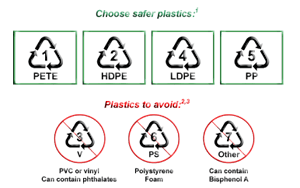
We can limit exposure by choosing better plastics, not heating food in plastic containers, reduce consumption of canned foods, wash hands after handling thermal receipts, do not allow babies or children to drink from plastic containers. Purchase stainless steel and glass containers for food & beverage consumption.


As nurses, we CAN reduce body burden on ourselves, peers, friends, family and our communities. We start by seeking the evidence. We pursue truth in labeling through policy and advocacy. We promote healthier choices and support companies who are transparent and producing non-toxic products. We consistently avoid and call out companies who are NOT transparent and raise our voices against them.
We cannot become overwhelmed by this knowledge and let it paralyze us. We have a responsibility and a duty as nurses to be scientists, advocates and change agents.
One way to stay engaged is to attend the Clean Med Summit in Nashville this May! Who's in?


I think we all were victims of BPA, I sometimes keep the little plastic containers when I buy turkey or ham and I reuse them to store food and microwave in them.Yikes! I don't even want to read anymore because I feel that I have been fully exposed to everything, including lead, mercury and several pesticides. I would be very afraid to have my blood checked.
ReplyDelete